Key Takeaways
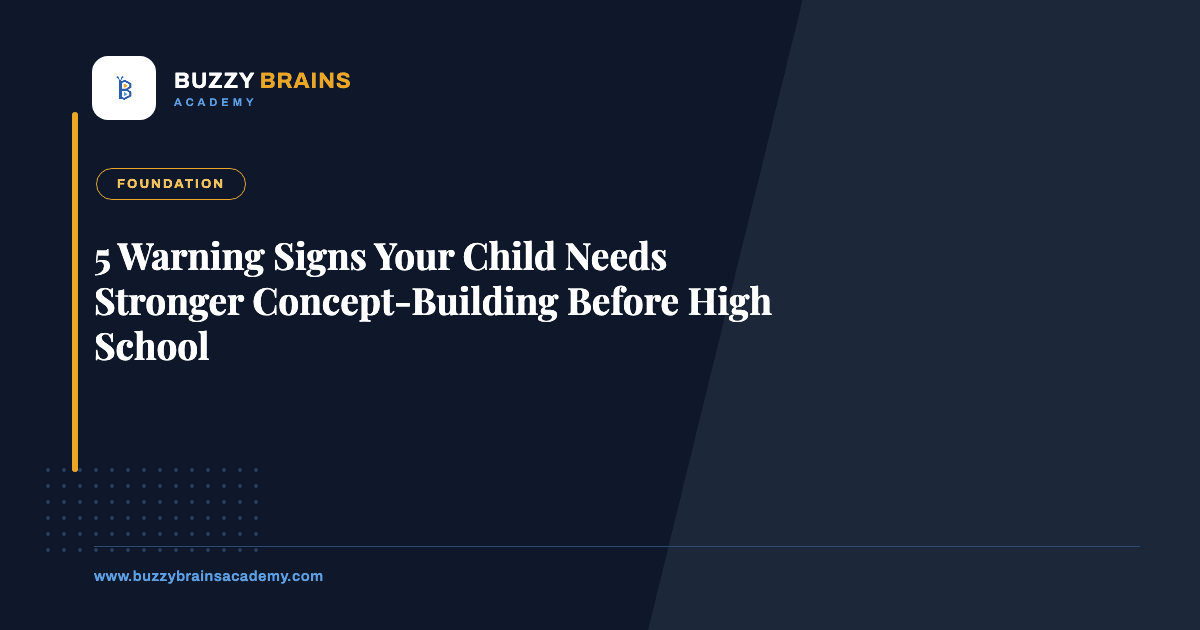
- These five warning signs are typically invisible on a report card, which is exactly why they need deliberate, active checking rather than passive grade-watching.
- "Can apply the formula but can't explain why" is the single most common and most telling sign of a rote-learned, rather than genuinely understood, concept.
- A specific struggle with word problems (versus direct-method questions) usually signals a translation gap, not a content gap.
- Quietly avoiding a subject is often misread as laziness or disinterest, when it's frequently a coping response to unacknowledged confusion.
- A free diagnostic assessment is the most reliable way to confirm whether a suspected warning sign reflects a real, specific gap.
Sign 1: Can Apply a Formula, But Can't Explain Why It Works
Ask your child to explain, in their own words, why a formula they use confidently actually works — not just to recite the formula or solve a practice question with it. A student who can only say "that's just the formula" or "that's what the teacher said to do" has memorized a procedure without the underlying understanding, which is precisely the kind of gap that surfaces painfully later, when the same concept appears in an unfamiliar format.
Sign 2: Handles Direct Questions Fine, But Struggles Specifically With Word Problems
If a child can solve "3/4 × 2/5" without hesitation but freezes on a word problem requiring the exact same calculation embedded in a real-world scenario, the issue usually isn't the maths itself — it's the translation step, converting a described situation into the right mathematical operation. This translation skill is exactly what competitive exams test heavily, and it's often under-practiced in school settings that emphasize direct-method drilling.
Sign 3: Has Started Quietly Avoiding Science or Maths
A child who used to engage with a subject and has recently started finding reasons to skip it, delay homework, or dismiss it as "boring," is often not genuinely bored — they're avoiding a subject where confusion has built up silently and gone unacknowledged. Kids are often reluctant to say "I don't understand this" directly, especially once they've fallen behind quietly enough that admitting it feels embarrassing; avoidance is frequently the visible symptom of that unspoken gap.
Sign 4: Forgets a Topic Quickly Once the Unit Test Is Over
If a concept that scored well on a recent unit test seems to have evaporated a month or two later, that's a strong signal the material was memorized for the specific test rather than genuinely understood and anchored. Genuinely understood concepts tend to persist, because they're connected to a broader framework of reasoning rather than isolated, short-term recall.
Got a question about this?
Talk to a Foundation Program mentor directly — no form, just a quick WhatsApp chat.
Sign 5: Needs a Worked Example to Look Nearly Identical Before Attempting a New Problem
Watch for a pattern where a student can solve a new problem confidently only when it closely resembles a worked example they've already seen, but hesitates or gives up when the problem is structured even slightly differently despite testing the same underlying concept. This is one of the clearest behavioral signs of pattern-matching rather than genuine conceptual flexibility.
A Quick Self-Check Summary
| Warning Sign | What It Usually Signals |
|---|---|
| Can't explain why a formula works | Memorized procedure, not genuine understanding |
| Struggles specifically with word problems | A translation gap, not a pure content gap |
| Quietly avoiding Science or Maths | Unacknowledged confusion, not genuine disinterest |
| Forgets a topic soon after the unit test | Short-term memorization rather than durable understanding |
| Needs an example to look nearly identical to attempt a new problem | Pattern-matching rather than conceptual flexibility |
What to Do If You Recognize One or More of These Signs
Noticing one of these signs isn't a cause for alarm — it's genuinely useful, actionable information, and every one of them is fixable with the right, deliberate approach. The most reliable next step is a structured diagnostic assessment, which tests the underlying concept directly rather than relying on parent observation alone, and identifies exactly which specific gaps need attention before high school raises the stakes and the material builds further on top of them.
Expert Tips from BuzzyBrains Academy Faculty
Founder Dilip Sah (25+ years of mentoring experience) built the Foundation Program's early-detection process around exactly these signs:
- A free diagnostic assessment maps these exact patterns — formula-without-understanding, word-problem struggles, pattern-matching dependency — precisely, not just generally.
- Small batches (max 12 students) let mentors notice a subtle avoidance pattern or hesitation individually, something that's genuinely hard to catch in a large classroom.
- The Discover → Understand → Practice → Excel methodology is specifically designed to close the "formula without why" gap, since Discover and Understand deliberately precede Practice.